by Ricardo Brites, PhD Eng°, Director of Engineering & VDC
For most of modern history, the way in which we build homes has evolved far less than the way in which we live in them. Residential construction has remained largely static — constrained by labor availability, fragmented delivery models, and carbon-intensive materials.
And now, we face a need for adaptation. With mounting affordability and climate pressures, cities need to build denser, higher-performing housing that can scale quickly and responsibly.
Mass timber, I believe, provides a rare opportunity to rethink the residential status quo by offering benefits to not just builders and cities, but to those who live inside the homes as well.
Why Density Changes the Equation
In single-family housing, conventional wood framing remains highly cost-effective. Decades of optimization, a mature labor base, and widely available engineered wood products make it difficult — and often impractical — for mass timber systems to compete on pricing today. As a result, mass timber single-family homes tend to occupy a premium niche: custom builds, fire-rebuilds, and design-forward projects where performance, resilience, and architectural quality justify added investment.
But the economics shift dramatically as buildings go vertical.
Once housing moves beyond four or five stories, traditional wood framing gives way to concrete and steel. It’s in this transition zone of the “missing middle”, and in mid-rise multifamily that mass timber becomes not just viable, but compelling.
An Engineered Material Built for Scale
More than a century ago, European builders began laminating smaller pieces of wood into stronger, more reliable structural members — what became glulam. That early shift proved timber could be engineered for consistency, safety, and scale.
The commercial development of cross-laminated timber (CLT) in the early 2000s extended those principles further, introducing large, precision-made panels capable of forming wood plates ideal for floors, walls, and roofs. Paired with computer-aided digital fabrication and more stringent thermal and sustainability upgrades, mass timber evolved from a niche structural solution into a repeatable building system particularly well suited to mid-rise residential construction.Today, mass timber is delivering results in multifamily buildings across North America, offering faster installation, lighter structural systems, and meaningful reductions in embodied carbon compared to concrete and steel.
Mass Timber Creates Homes That Protect and Adapt
One of the most immediate benefits of mass timber is also one of the most human: how it feels to live within it.
In multi-unit residential environments, exposed timber interiors improve occupant comfort and wellness by creating calm, quiet spaces that feel more human at scale. Studies show that mass timber’s biophilic properties, particularly relative to conventional construction, contribute to reduced stress and improved well-being.
But the appeal is beyond aesthetic. Mass timber homes are engineered for strength and resilience too. Thick timber panels perform exceptionally well in fire by charring predictably and maintaining structural integrity. They also offer strong seismic performance due to their low weight and high system ductility—an increasingly important consideration in many regions.
For cities densifying under climate, affordability, and livability pressures, these qualities have become foundational.
From Urban Density to Custom Homes: Mass Timber’s Dual Trajectory
From my perspective, mass timber’s role in housing will not follow a single trajectory — it will diverge by building type.
Now – 2030
Early adopters in Single-Family Homes: Designing What’s Possible
In the near term, mass timber single-family homes will remain a premium product. These projects showcase what’s possible: resilience, speed of enclosure, precision, and architectural quality. They also serve as testbeds for digital design workflows, prefabrication techniques, and supply-chain learning that will ultimately inform larger-scale housing delivery.
What’s accelerating adoption isn’t just the material itself, but the tools surrounding it. Computer assisted platforms and emerging AI-assisted modeling are already reducing coordination cycles, improving material takeoffs, and lowering soft-cost and risk. What once required months of back-and-forth between architects, engineers, and fabricators can now be virtually validated in real time.
Now – 2035
Multifamily Momentum: Competing Where It Counts
The real opportunity lies in mid-rise and taller residential buildings. In this range, mass timber — particularly when combined with cold-formed steel (CFS) in hybrid systems — competes directly with concrete and steel on schedule certainty, labor efficiency, and total project risk. This is where cost curves flatten, carbon savings compound, and repeatability becomes possible.
Incremental automation—CNC routing, layout assistance, materials handling—will further improve throughput and reliability in fabrication. For homeowners, that translates to shorter build times, reliable supply and homes that perform as promised.
Mid-203os and Beyond
Mainstream Viability: From Projects to Platforms
This is the moment when mass timber mirrors the path of concrete modular and panelized construction systems: once considered “alternative,” now accepted as part of the mainstream toolkit. Automation, AI-assisted detailing, and validated system libraries compress delivery timelines and stabilize pricing — enabling broader adoption across regions and markets.
Learning from Where It’s Already Working
Mass timber’s success in mid-rise residential construction provides a blueprint for scaling. These projects demonstrate that hybrid timber systems can meet safety requirements, accelerate schedules, and materially reduce embodied carbon — all while delivering high-quality housing at density.
To move from bespoke buildings to repeatable housing, the industry must continue shifting effort upstream. Early-stage validation, standardized assemblies, and digital tools that de-risk hybrid systems before construction begins are essential.
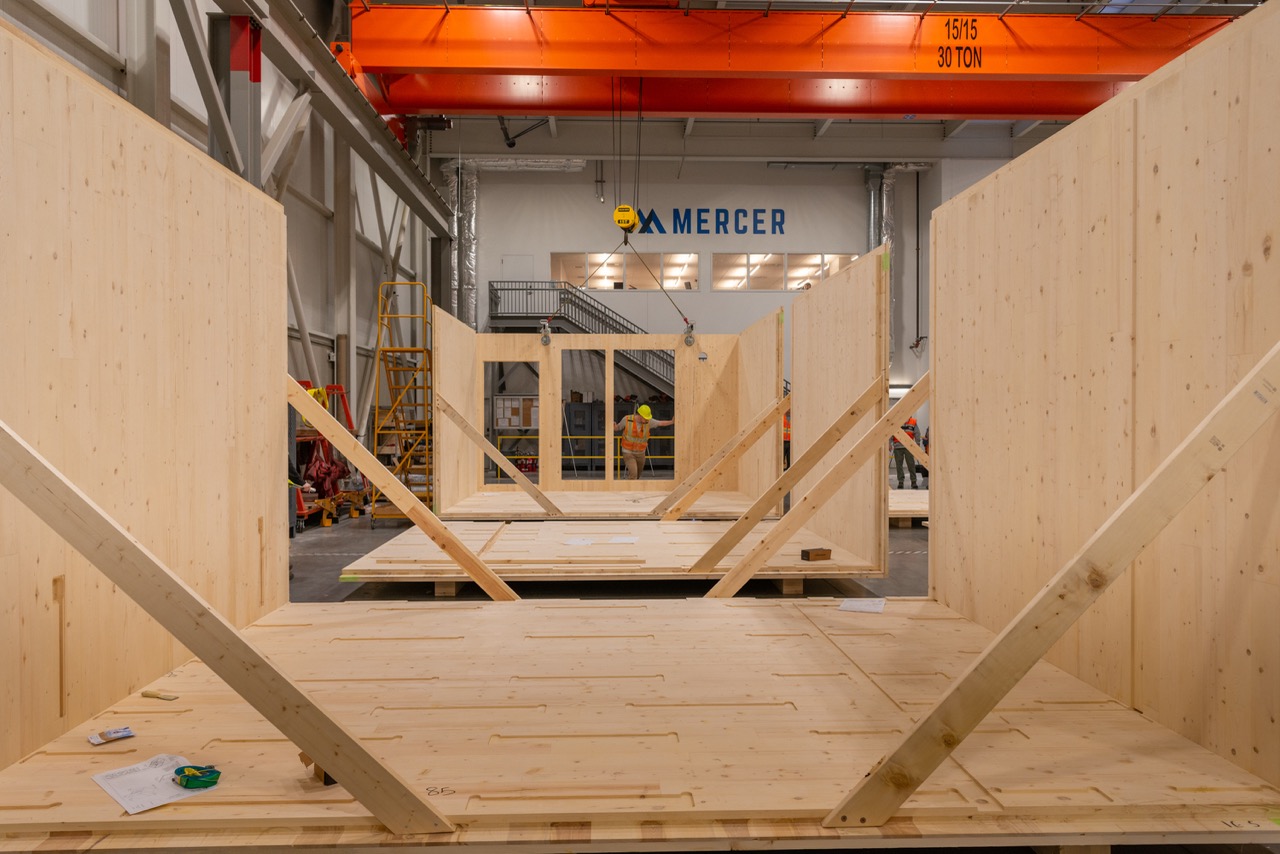
Building on this momentum, Mercer Mass Timber is developing a Hybrid Building Systems Design Tool1 to streamline residential construction and enhance affordability as prefabricated homes become more common.
The web-based application provides real-time structural and architectural pre-validation for cold-formed steel (CFS) and cross-laminated timber (CLT) hybrid systems, accelerating go-to-market timelines for projects from low-rise to high-rise. In doing so, it helps offset carbon-intensive construction typologies (concrete, steel) methods with solutions that are durable, adaptable, and viable across regions.
The Right Tool for the Right Moment
The future of housing will be defined by systems that reduce risk, accelerate delivery, and perform across regions and typologies. Hybrid mass timber construction, supported by early validation and digital tools, offers a clear path forward. The opportunity in front of us is execution, and the tools to make it repeatable.